Current Sensor
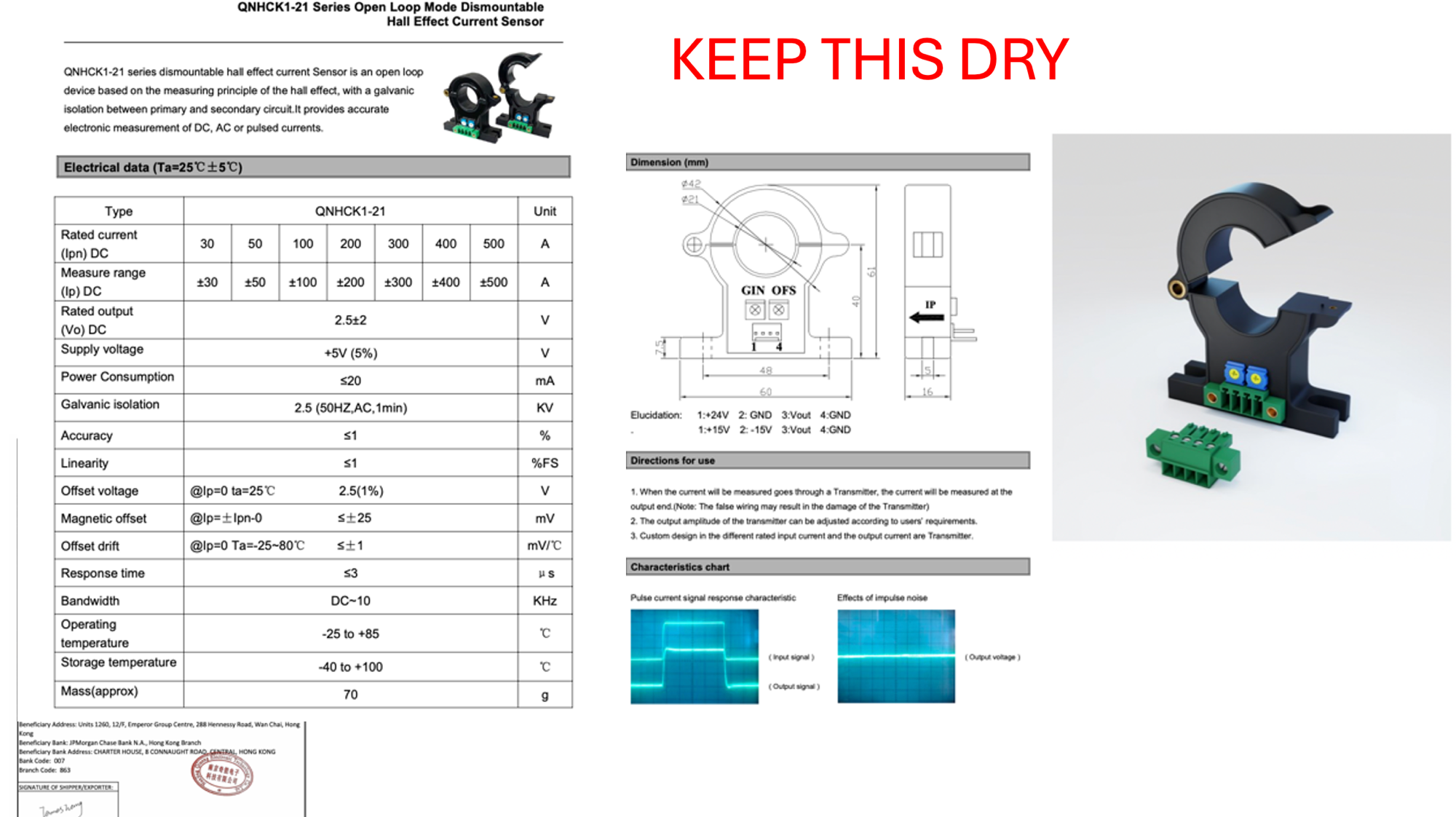
Part: QNHCK1-21 — Open Loop Hall Effect Current Sensor, dismountable, 300 A. Galvanically isolated output; measures DC, AC, or pulsed current.
Mounting and wiring instructions are in Installation → Sensors → Current Sensor. This page is the technical reference; QNHCK1-21 Hall Current Sensor has the teardown photographs.
Why an open-loop Hall sensor
A traditional shunt requires breaking the high-current path and inserting a precision resistor — every connection is a failure point carrying full alternator output, and the measurement leads sit at battery potential. The Hall clamp avoids all of that: the cable passes through uncut, the sensor output is galvanically isolated (2.5 kV) from the conductor, and the sensor can be added to or removed from an existing installation without touching the high-current wiring.
The trade-off is accuracy — roughly 1% for this sensor versus 0.1%-class for a good shunt. For field control purposes that is more than sufficient: the control loop needs a fast, stable current signal, not laboratory absolute accuracy. (Battery current, where coulomb-counting accuracy does matter, is measured separately by the precision battery monitor (INA228) and its shunt — see BatteryV and Current Monitor.)
Specifications (300 A version, shipping standard)
| Parameter | Value |
|---|---|
| Rated current | 300 A DC |
| Measure range | ±300 A |
| Output voltage | 2.5 V ± 2 V |
| Supply voltage | +5 V (±5%) |
| Power consumption | ≤ 20 mA |
| Galvanic isolation | 2.5 kV |
| Accuracy | ≤ 1% |
| Response time | ≤ 3 µs |
| Bandwidth | DC – 10 kHz |
| Operating temperature | −25 to +85 °C |
Output scale: 0 A → 2.5 V midpoint. Full positive (300 A) → 4.5 V. Full negative (−300 A) → 0.5 V. Linear across the full range (6.7 mV per amp).
The dashboard's Hall Effect Sensor Range setting (AmpSensorRange, under Setup → Alternator → Basic → Current Sensing) tells the firmware this scale and must be left on 300 A for the shipped sensor — other values exist only for substitute sensors with different ratings.
How the regulator reads it
The sensor output lands on analog input channel 1 (AIN1) of the analog front end, carried on Cable 1 along with the sensor's 5 V supply and ground — pin assignments in Data Cables & Pinout.
Alternator current feeds the fastest control loop in the XREG-010, so this channel gets priority in the analog sampling schedule — it takes three of the six slots in the conversion sequence, giving roughly a hundred samples per second, three times the rate of the other analog channels. The full signal chain (op-amp buffering, protection, ADC configuration) is documented in Analog Inputs.