Digital Inputs
The XREG-010 has two different styles of digital input architectures, depending on the pin in question. They are all exposed in the Ethernet Connectors (see Data Cables & Pinout).
- Optocoupler Style — Activated by a positive voltage input (rated 5–28 V applied to the input pin; survives to 54 V)
- Ground Style — Activated by shorting the input pin to ground
The two styles serve different installation scenarios: opto-style inputs are right for signals coming from elsewhere in the boat's 12/24/36/48 V system (ignition, BMS contacts, mode-switch outputs), because the channel accepts anything from 5 to 28 V without a divider and the series resistor, LED drop and reverse clamp keep that wire's transients away from the ESP32 pin. Ground-style inputs are right for local switches mounted near the regulator that simply close to its own GND — they consume less idle power, eliminate the optocoupler aging concern, and are appropriate when the signal source is electrically local.
Optocoupler Channel Map (5 channels)
| Function | Opto IC | Clamp Diode | ESP32 GPIO |
|---|---|---|---|
| IGNITION (engine wake) | U5 | D19 | GPIO1 |
| HIGH/LOW (charging mode) | U10 | D25 | GPIO39 |
| BMSLogic (BMS enable) | U16 | D27 | GPIO42 |
| FORCEFLOAT (force float mode) | U17 | D28 | GPIO40 |
| EXTRA_OPTICAL_GPIO1 (spare) | U26 | D34 | GPIO8 |
All five channels are identical optically and electrically — only the destination GPIO differs. The V9 schematic below shows one real channel (U26, the spare EXTRA_OPTICAL_GPIO1 input); substitute the relevant designators from the table above for any other channel.
Optocoupler Style Digital Inputs
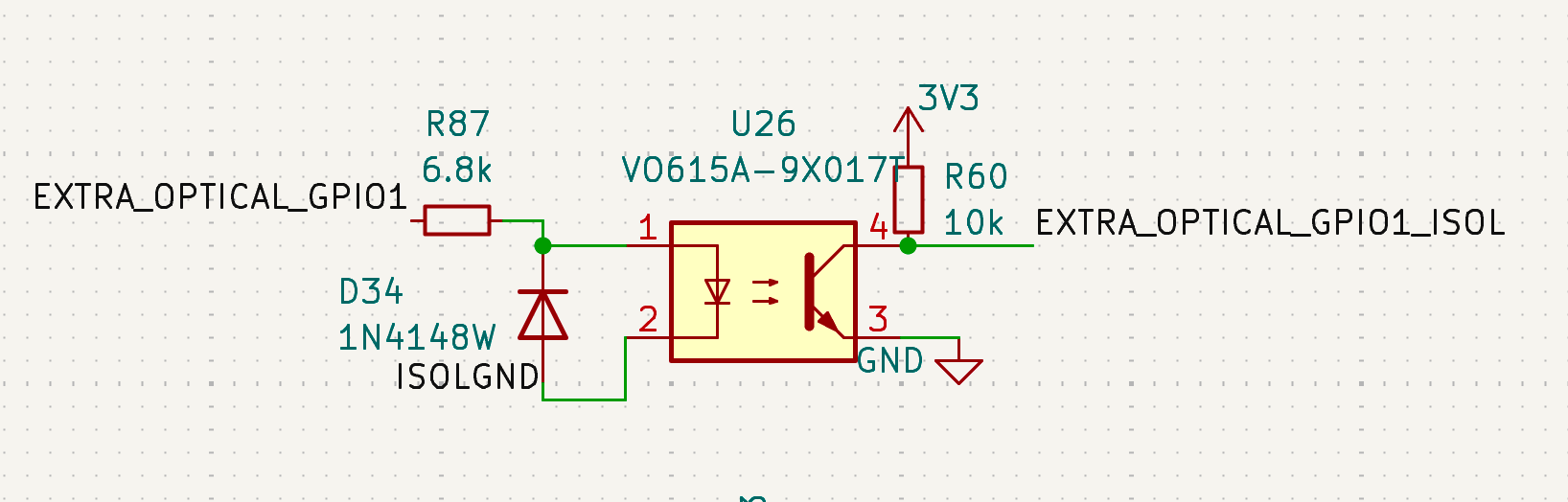
The input side (left) takes the external 5–28 V signal through the 6.8 kΩ series resistor and back through the LED; the output side (right) is the phototransistor pulling the ESP32 GPIO low against the 10 kΩ pull-up to 3.3 V.
Design Requirements
- Input voltage range: the published user-facing rating is 5–28 V (this keeps LED current in the 10+ year lifetime zone — see the table below). The circuit itself survives to 54 V with reduced LED lifetime.
- Temperature range: -40°F to 180°F (-40°C to 82°C) — well inside the VO615A's -55 °C to +110 °C rating
- Lifetime target: 10+ years at typical voltages (~12V), 3-6 years at the 54V survival limit
How an Optocoupler Works
The VO615A carries the signal from the input circuit to the ESP32 GPIO as light rather than as a direct electrical path:
Input Side (LED)
- Input voltage applied across current limiting resistor and IR LED
- Forward current flows through LED, producing infrared light
- Light intensity proportional to forward current
Output (ESP32 GPIO) Side (Phototransistor)
- IR light strikes phototransistor base region
- Light creates electron-hole pairs, acting as base current
- Transistor turns on, allowing collector current to flow
- Collector current = LED current × CTR (Current Transfer Ratio)
- When sufficient collector current flows, voltage at collector drops low enough to register as logic LOW on ESP32
- Voltage otherwise pulled high (3.3V) by pull up resistor to 3.3V Supply
Protection and Range
- Protection: a transient on the input wire drives LED current and returns through the LED loop — the only path onward to the GPIO node is optical, so the spike never reaches the pin
- Range: accepts input signals from 5 V to 54 V with no divider (lower LED life at higher voltages)
Component Selection
Optocoupler: VO615A-9X017T (LCSC C145478)
Decoding the part number against the datasheet's ordering-information table:
- -9 — CTR bin 9: 200–400 %, specified at IF = 5 mA, VCE = 5 V. (The unbinned base VO615A spans 50–600 % at the same test point.)
- X017T — SMD-4, package option 7, from the VDE-approved block (the "1" = option 1, DIN EN 60747-5-5 / VDE 0884-5); T = tape and reel.
- Agency approvals: UL 1577 / cUL, BSI, FIMKO, CQC, plus VDE with option 1.
Reason for the high-CTR bin: reliable switching at the 5 V low end, minimal extra cost.
CTR is specified at 5 mA — not at our low-end operating point
The 200–400 % bin is measured at IF = 5 mA. CTR falls off at lower LED current, so at the 5 V input level (IF ≈ 0.53 mA) the effective CTR is well below 200 %. The low-end analysis below therefore checks against the pull-up threshold current, not against the headline CTR number.
Current Limiting Resistor: 6.8kΩ, 1W, 2512 SMD
- Calculation basis:
- At 5V: IF = (5V - 1.43V) / 6.8kΩ = 0.53 mA
- At 54V: IF = (54V - 1.43V) / 6.8kΩ = 7.7 mA
- Power rating: 404mW at 54V requires 1W resistor for safety margin
Pull-up Resistor: 10kΩ, 0603 SMD (R60 shown for the U26 channel)
- Logic HIGH: When LED is OFF, phototransistor is OFF, collector pulled to 3.3V through 10kΩ
- Logic LOW: When LED is ON, phototransistor conducts, pulling collector toward ground
- Threshold current: the phototransistor must sink 3.3 V / 10 kΩ = 0.33 mA to pull the collector fully low
- Switching threshold: ESP32 typically switches at ~1.65V (50% of 3.3V), so even ~0.17 mA of collector current crosses the logic threshold
Performance Analysis
| Input Voltage | LED Current | vs Min (1mA) | Lifetime | Power (Watts) | Power (mA@12V) |
|---|---|---|---|---|---|
| 5V | 0.53 mA | 53% of min | 20+ years | 1.9 mW | 0.16 mA |
| 12V | 1.57 mA | 157% of min | 20+ years | 17 mW | 1.4 mA |
| 28V | 3.91 mA | 391% of min | 10+ years | 104 mW | 8.7 mA |
| 54V | 7.7 mA | 770% of min | 3-6 years | 404 mW | 33.7 mA |
Power consumption notes: - Power is consumed only when Input Signal is active (ie external switch is ON) - No power consumption when Input Signal = 0V (ie external switch OFF) - LED power = Forward current × 1.43V (LED forward voltage) - Resistor power = Forward current² × 6.8kΩ
Protection Diode: 1N4148W (SOD-123)
Function: Reverse Voltage Protection
The 1N4148W diode (SOD-123 package, LCSC C81598 — V9 BOM lists one per opto channel at D19, D25, D27, D28, D34) provides critical protection for the optocoupler LED:
- Normal operation: Diode is reverse biased across LED, no current flows
- Reverse voltage protection: If Input Signal goes negative, diode conducts and clamps reverse voltage to ~0.7V
- Prevents LED damage: VO615A LED can only handle 6V reverse voltage maximum
Why Critical
- Load dump transients: Long wires / disconnection can create voltage spikes
- Electrical noise: Marine electrical systems are electrically noisy environments
Specifications & Failure Limits
- Forward voltage: 0.7V typical, 1.25V maximum at 10mA
- Reverse voltage rating: 75V maximum
- Forward current rating: 300mA continuous, 2A peak (1µs pulse)
- Power dissipation: 350mW at 25°C
Failure Analysis
The diode will fail if: - Forward current > 300mA continuous: At maximum negative transient - Reverse voltage > 75V: If positive Input Signal exceeds 75V (well above our 54 V max) - Power dissipation > 350mW: P = If × 0.7V, so fails at If > 500mA
The 1N4148W provides robust protection for all expected marine transient conditions.
System Power Consumption
| Condition | LED Side | ESP32 Side | Total Power | Total (mA@12V) |
|---|---|---|---|---|
| Input OFF | 0 mW | ~0 mW | ~0 mW | ~0 mA |
| Input ON (12V) | 17 mW | 1.09 mW | 18 mW | 1.5 mA |
| Input ON (54V) | 404 mW | 1.09 mW | 405 mW | 33.8 mA |
The ESP32-side 1.09 mW is the 10 kΩ pull-up conducting to ground through the phototransistor (3.3 V² / 10 kΩ) — it flows only while the input is active. With the input off, the phototransistor is off and the collector node is high-impedance, so the pull-up sources nothing: an idle opto channel consumes zero power on both sides.
LED Current Guidelines
- 1-3mA: Conservative operation (20+ year lifetime)
- 3-8mA: Moderate operation (5-10 year lifetime)
- 8-15mA: Aggressive operation (1-5 year lifetime)
Design Validation
- 5V switching: at 5 V the LED runs ≈ 0.53 mA. Even with CTR derated well below the 5 mA-spec 200 % floor, the phototransistor only has to sink 0.33 mA (the 10 kΩ pull-up's full-swing current) — and only ~0.17 mA to cross the ESP32 logic threshold — so switching remains reliable at the bottom of the range
- 54V survival: 7.7mA current provides marginal 3-6 year life if 100% duty cycle
- Temperature performance: VO615A-9's high CTR provides margin for temperature derating across -40°F to 180°F range
Bill of Materials (Optocoupler Style — per channel)
| Reference (per channel) | Part Number | Description | Package | LCSC |
|---|---|---|---|---|
| U5 / U10 / U16 / U17 / U26 | VO615A-9X017T | Optocoupler, CTR 200–400 % | SMDIP-4 | C145478 |
| R67 / R74 / R75 / R76 / R87 (one per channel, same order as the channel map) | 25121WJ0682T4E | Current-limit resistor, 6.8 kΩ, 1 W | 2512 | C26073 |
| R46 / R47 / R51 / R52 / R60 (one per channel, same order as the channel map) | — | Pull-up resistor, 10 kΩ, to 3V3 | 0603 | C25804 |
| D19 / D25 / D27 / D28 / D34 | 1N4148W | Reverse-bias protection diode | SOD-123 | C81598 |
The 6.8 kΩ 2512 part is shared by the five opto LED-drive series resistors and the buzzer-circuit gate pull-up (R65). The output pull-ups (R60 shown for the U26 channel) come from the board-wide shared 10 kΩ pool.
Ground Style Digital Inputs
Schematic
3.3V ──[R57:10kΩ]──┬──[C51:1µF]──GND
                   │
                   ├──[D32: PESD5V0S1BA TVS]──GND
                   │
                   ├── Input Signal (RJ45 pin)
                   │
                   └──[R104:330Ω]── ESP32 GPIO41
The pull-up, debounce capacitor, and TVS all sit on the connector node; the 330 Ω series resistor is between that node and the ESP32 pin. Designators above are the FactoryReset channel; the four switch inputs are identical:
| Function | Cable 4 pin | Pull-up | Capacitor | TVS | Series resistor | ESP32 GPIO |
|---|---|---|---|---|---|---|
| FactoryReset | 9 | R57 | C51 | D32 | R104 | GPIO41 |
| WakeFromSleep | 10 | R82 | C52 | D38 | R58 | GPIO5 |
| WifiReset | 11 | R83 | C53 | D39 | R105 | GPIO45 |
| AP/ClientMode | 12 | R84 | C59 | D40 | R56 | GPIO46 |
The GPIO0 boot strap (Cable 3 pin 8: R43, C30, D4, R71) and the RESET line (Cable 4 pin 13: R33, C60, D35, R98 into the module's EN pin) use the same circuit.
Design Requirements
- Input method: Short to ground activation
- Temperature range: -40°F to 180°F (-40°C to 82°C)
- Debouncing: Hardware RC filter for switch bounce elimination
- Protection: series resistance and a PESD5V0S1BA TVS on each exposed input
How Ground Style Inputs Work
This design uses RC debounce filtering:
Normal Operation (Switch Open)
- Input Signal is not connected (floating or open)
- No current flows to Ground
- Pull-up resistor R57 (10kΩ) pulls GPIO pin to 3.3V
- ESP32 GPIO reads logic HIGH (3.3V)
Activated Operation (Switch Closed to Ground)
- Input Signal is shorted to ground by external switch/contact
- Current flows from 3.3V through R57 (10kΩ) to ground via the switch
- Junction voltage: V_out = 0V (direct connection to ground)
- ESP32 GPIO reads logic LOW (0V << 0.8V threshold)
Component Analysis
Pull-up Resistor: R57 (10kΩ)
- Function: Pulls Output Signal HIGH when Input Signal is not grounded
- Power when input open: ~0 mW — the switch is open and the GPIO input is high-impedance, so the pull-up has no current path
- Power when input grounded: P = 3.3V²/10kΩ = 1.089 mW (continuous while held closed)
Debounce Capacitor: C51 (1µF)
- Function: Filters switch bounce and electrical noise
- Time constant: τ = R57 × C51 = 10kΩ × 1µF = 10ms
- Settling time: ~3τ = 30ms for clean switching
- Noise immunity: Filters high-frequency electrical noise
TVS: D32 (PESD5V0S1BA, SOD-323)
- Function: bidirectional 5 V-standoff TVS from the connector node to ground; it clamps ESD and wiring transients before they reach the RC network and the ESP32
- Rating: 5 V reverse standoff, 12 A peak pulse current (8/20 µs)
Series Resistor: R104 (330 Ω, 0402)
- Function: sits between the connector node and the ESP32 pin, limiting the current the pin's internal clamps have to carry during a transient; it is not in the switch path, so it does not affect the logic levels
Performance Analysis
Switching Characteristics
- Rise time: Limited by RC time constant = 10ms
- Fall time: Much faster, limited by the 330 Ω series resistor (R104) and ESP32 input capacitance
- Debounce time: ~30ms eliminates typical switch bounce
Power Consumption
| Condition | Current | Power | Power (mA@12V) |
|---|---|---|---|
| Input Open | ~0 mA | ~0 mW | ~0 mA |
| Input Grounded | 0.33 mA | 1.089 mW | 0.09 mA |
Power consumption notes: - Power flows only while the switch is held closed — an open input draws nothing (high-impedance GPIO leaves the pull-up with no current path) - Very low power consumption suitable for battery applications - Worst case (switch held closed continuously) is still only ~1.1 mW
Voltage Levels
- Logic HIGH: 3.3V (input open/floating)
- Logic LOW: 0 V (the switch shorts the connector node directly to ground; the 330 Ω series resistor is between that node and the GPIO, not in the switch path)
- Switching threshold: ESP32 switches at ~0.8V, providing excellent noise margin
- Noise margin HIGH: 3.3V - 0.8V = 2.5V
- Noise margin LOW: 0.8V - 0V = 0.8V
ESP32-S3 Internal ESD Protection and Real ESD Event Analysis
ESP32-S3 Internal Protection Specifications
From the ESP32-S3 datasheet:
- Human Body Model (HBM) ESD tolerance: ±2000V
- Charged Device Model (CDM) ESD tolerance: ±1000V
- Absolute maximum input voltage: 3.6V (VDD + 0.3V)
- Internal protection: Snapback devices on all GPIO pins
What Happens During an ESD Event
Scenario: 8kV HBM discharge to Input Signal wire
- Initial ESD pulse: 8000V spike from a 100 pF source through ~1.5kΩ (HBM model)
- TVS (D32) and debounce capacitor (C51) take the hit: the discharge lands on the connector node, where D32 clamps the voltage and the 1 µF capacitor is 10,000 times the HBM source capacitance. 100 pF at 8 kV is 0.8 µC, which raises 1 µF by about 0.8 V
- Series resistor (R104): the 330 Ω between the connector node and the GPIO limits the current the pin has to carry
- ESP32 internal protection response:
- Internal snapback devices activate at ~7-10V
- Snapback devices clamp GPIO voltage to ~5-7V
- Current flows through internal protection to chip ground
- Current path: ESD energy → D32 clamps the connector node while C51 absorbs the charge → R104 → ESP32 internal snapback → chip ground
- Result: GPIO survives due to the TVS, the capacitor, the series resistor, and the internal clamps
Role of the ESP32's Internal Protection
The key insight: The ESP32's internal ESD protection is designed to handle exactly this scenario. The internal snapback devices are specifically designed for ESD events where voltage exceeds normal operating range.
Espressif's official position (from ESP32 forum): "The ESP32 has internal snapback devices in order to handle ESD on all pins. The external ESD protector is simply a belts-and-braces approach to make sure someone doesn't accidentally zap through the internal protections."
Design Validation for ESD Protection
IEC 61000-4-2 Contact Discharge (typical requirement): - Test voltage: ±8kV - The figures above are analysis, not a compliance test result - Reasoning: the 1 µF capacitor takes the charge, the 330 Ω resistor limits the current, and the internal clamps handle the residual
Real-world ESD sources:
- Human walking on carpet: 2-15kV
- Handling in dry environment: 5-25kV
- Protection margin: Adequate for typical applications
The design provides ESD protection through the combination of the 1 µF capacitor at the connector node, the 330 Ω series resistor and the ESP32's internal snapback protection. The 330 Ω value is small enough not to affect digital operation.
Design Validation
- Noise immunity: 1µF capacitor filters electrical noise
- ESD protection: a PESD5V0S1BA TVS and 1 µF at the connector node, plus a 330 Ω series resistor ahead of the ESP32's internal clamps
- Current limiting: 330 Ω series resistor between the connector node and the GPIO
- Low power: <1.1mW continuous power consumption
- Switching margin: large noise margins on both logic levels
Bill of Materials (Ground Style — per channel)
| Reference (representative) | Part Number | Description | Package | Notes |
|---|---|---|---|---|
| R57 / R82 / R83 / R84 | 10 kΩ 0603 (LCSC C25804) | Pull-up to 3V3 | 0603 | Shared 10 kΩ pool across the board |
| C51 / C52 / C53 / C59 | 1 µF 0603 (LCSC C15849) | RC debounce cap | 0603 | Shared 1 µF pool |
| R104 / R58 / R105 / R56 | 330 Ω 0402 (LCSC C25104) | Series resistor between the connector node and the GPIO | 0402 | Shared 330 Ω pool |
| D32 / D38 / D39 / D40 | PESD5V0S1BA (LCSC C19224) | 5 V bidirectional TVS to GND | SOD-323 | One per input node |
Comparison: Optocoupler vs Ground Style
| Feature | Optocoupler Style | Ground Style |
|---|---|---|
| Input Range | 5V to 28V rated (54V survival) | Ground short only |
| Power (Active) | 1.5–33.8 mA @ 12V | 0.09 mA @ 12V |
| Power (Inactive) | ~0 mA | ~0 mA |
| Component Count | 4 components | 4 components |
| Cost | Higher (optocoupler) | Lower (passive) |
| Complexity | Medium | Low |
| Noise Immunity | Excellent | Good |
| Applications | 5–28 V signals from elsewhere on the boat | Simple switches, low voltage |