Temperature Sensors
The XREG-010 supports two alternator temperature sensor types, with a third theoretically possible:
| Option | Recommendation | Interface |
|---|---|---|
| Digital sensor (DS18B20) — included | Recommended | Dedicated digital (1-Wire) input on Cable 1 |
| 10 kΩ NTC thermistor | Supported, not recommended | Analog Channel 3 (AIN3) |
| Analog IC sensor (TMP235) | Theoretically possible, untested | Analog Channel 3 (AIN3) |
Installation of the included digital sensor is covered in Installation → Sensors → Temperature Sensors.
Digital sensor (DS18B20) — recommended
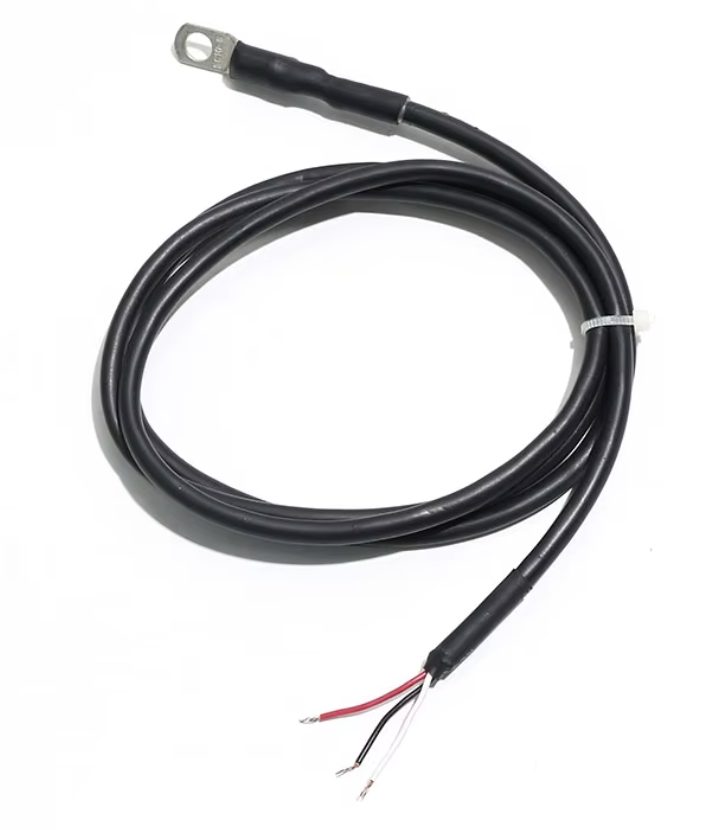
Three are supplied with the regulator, factory-sealed into ring lugs (M4, M5, and M8 hole sizes) on 0.5 m leads. All three share the one 1-Wire bus on Cable 1 pins 1, 2 and 3 (3.3 V, GND, data); the battery and extra probes join it in parallel through an RJ45 splitter at the regulator. The firmware reads every probe on the bus on the same 5 s cycle and tells them apart by serial number; each probe's role (alternator, battery, or extra) is assigned under Setup → Temperature → Temperature Sensors.
Advantages over thermistors
The reading is digital data, not an analog level, so lead resistance, connector corrosion, and electrical noise cannot shift the temperature value; a corrupted transmission fails its integrity check (CRC) and is discarded rather than silently read wrong. It is also factory calibrated — ±0.5 °C typical accuracy across the alternator operating range, with no user calibration constants to enter.
10 kΩ NTC thermistor — supported, not recommended
Analog Channel 3 (AIN3) accepts a standard 10 kΩ NTC thermistor wired against a 10 kΩ divider resistor on the board.
Why it's not recommended: the divider output approaches the 3.3 V rail above roughly 90–100 °C — exactly the band that matters for alternator protection. Resolution and accuracy drop sharply in that band: expect ±2–3 °C near 100 °C, degrading to ±3–5 °C at 125 °C, versus ±0.5 °C typical from the digital sensor. The full voltage table and accuracy comparison are below; the circuit itself (divider, ground jumper, disconnect detection) is in Analog Inputs → Channel 3.
To use one anyway:
- Remove the 0 Ω ground jumper on the board — Channel 3 ships shorted to ground as a spare ground pin. See Analog Inputs for the designator. That node is Cable 1 pin 6 and Cable 2 pin 12; with the jumper removed neither is a ground any more, so anything returned through them — the current sensor's power return on Cable 1 pin 6 in the standard wiring — must move to a true ground pin first (see Data Cables & Pinout).
- Wire the thermistor between 3.3 V and AIN3. The 3.3 V supply is the Orange/White wire on Cable 1 — the same wire that powers the digital temperature sensor, so both legs of the divider land on one cable. AIN3 is also brought out on Cable 2 (Blue), on the same net; pin assignments in Data Cables & Pinout.
- Under Setup → Alternator → Basic → Temperature Settings, enter the constants for your part: Thermistor Beta (from the thermistor datasheet — 3380 for the reference Murata NXFT15XH103FA2B050), Thermistor Series Resistor (10 kΩ as built), and Thermistor Reference Temp (25 °C for nearly all parts). Enter Beta carefully: a mismatched value reads correctly at 25 °C and increasingly wrong away from it. A Beta entered higher than the part's true value under-reads at high temperature, so high-temperature alarms fire late.
- Flip the Temp Source toggle from Digital to Thermistor.
Use 3.3 V excitation, not 5 V
5 V supply pins also exist on Cable 1 (pin 5) and Cable 2 (pin 14), but the firmware's thermistor conversion assumes 3.3 V excitation. Powering the divider from 5 V produces readings that are wrong everywhere except by coincidence, and pushes the divider output above the ADC's usable range at high temperature. Use the 3.3 V wire.
Other thermistor values
Any 10 kΩ NTC works with a settings change only — Beta values vary widely between vendors (3380, 3435, 3470, 3892, 3950, 4050, and 4250 K are all common), and the firmware accepts whatever the datasheet says.
Thermistors of other resistances (2 kΩ, 5 kΩ, 100 kΩ, etc.) are theoretically usable with one board change: replace the 10 kΩ divider resistor (the 0603 pulldown on Channel 3 — designator in Analog Inputs) with a value near the thermistor's 25 °C resistance, then set Thermistor Series Resistor to the installed value. Resolution is best when the fixed resistor roughly matches the thermistor's resistance in the temperature band you care about.
Analog IC sensor (TMP235) — theoretical, untested
A TI TMP235 temperature sensor IC uses the same circuit as the thermistor, unmodified. Power it from the same 3.3 V wire, tie its output to the same AIN3 node, and the existing 10 kΩ resistor — the divider bottom in the thermistor case — simply becomes a light load on the TMP235's low-impedance output. No board changes either way.
Its output is a linear voltage — 10 mV/°C with 0.5 V at 0 °C — which stays well-centered in the ADC range all the way past +140 °C, avoiding the thermistor's high-temperature compression entirely.
The caveat: current firmware converts Channel 3 through the thermistor equation (Beta model), so the TMP235's linear output would produce wrong readings without a firmware change to add a linear conversion mode. The hardware path is sound by analysis; nobody has tested one in an installation. If you want to try it, get in touch.
Accuracy and range comparison
Thermistor figures assume the reference Murata part with correct settings entered.
| Digital (DS18B20) | 10 kΩ NTC thermistor | TMP235 (A4 grade) | |
|---|---|---|---|
| Sensing range | −55 to +125 °C | −40 to +125 °C (resolution falls off above ~100 °C) | −40 to +150 °C |
| Accuracy, −10 to +85 °C | ±0.5 °C (datasheet max) | ±1 to 2 °C | ±1 °C typical |
| Accuracy at 100 °C | ±2 °C max bound (typically much better) | ±2–3 °C | ±1 °C typical |
| Accuracy at 125 °C | ±2 °C max bound | ±3–5 °C | ±1 °C typical |
| Signal at high temp | Digital — unaffected | Approaches the 3.3 V rail; resolution drops sharply above ~100 °C | Linear everywhere — 1.5 V at 100 °C, far from the rail |
| Corrupted-reading behavior | Fails checksum (CRC), discarded | Reads wrong silently | Reads wrong silently |
| Lead resistance / corrosion effect | None | Adds directly to apparent thermistor resistance | Negligible (low-impedance output) |
| Disconnect detection | No response on the data line | Node pulled to 0 V — below the 0.05 V "no sensor" floor | Same — node pulled to 0 V, detected (lowest real reading is 0.100 V at −40 °C) |
| Multiple sensors on one input | Yes — up to three probes wired in parallel on the same three wires, told apart by serial number | No — one thermistor per analog channel | No — one sensor per analog channel |
| Firmware support | Yes (default) | Yes (Temp Source → Thermistor) | Not yet — needs a linear conversion mode |
TMP235 accuracy figures are for the A4 grade (TMP235A4DCKR); its worst-case datasheet bound is ±2.5 °C anywhere in −40 to +150 °C, with no extra penalty at high temperature. An A2 grade (±0.5 °C typical) also exists.
An alternator protection sensor has to read accurately between roughly 90 and 125 °C. The thermistor is weakest exactly there — its divider output flattens against the supply rail, so each ADC step spans more degrees and part tolerances dominate. The chart below makes it visible: in the shaded protection band the thermistor curve has gone nearly flat while the TMP235 line keeps its full 10 mV/°C slope.
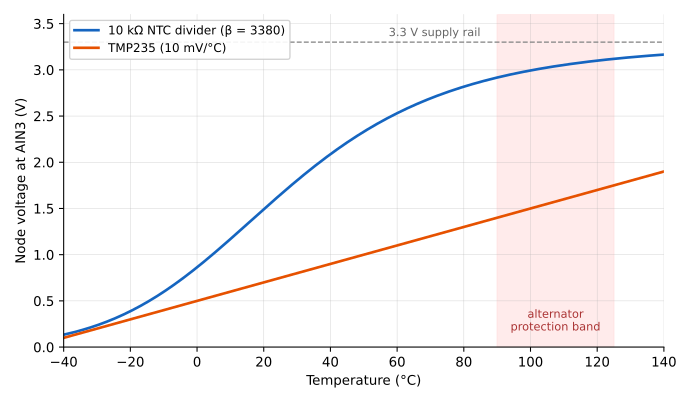
The DS18B20's accuracy bound also widens above 85 °C (the ±2 °C figure is the datasheet worst case), but its reading stays trustworthy: it cannot drift with wiring condition and cannot be silently corrupted by noise. The TMP235 would be the best analog performer at high temperature, which is why it is documented here despite being untested.
Output voltage by temperature (3.3 V excitation)
Computed from the Beta model (R25 = 10 kΩ, β = 3380 K) against the 10 kΩ divider resistor, and the TMP235 transfer function (0.500 V at 0 °C, 10 mV/°C):
| Temp (°C) | R_NTC (Ω) | NTC node (V) | TMP235 node (V) |
|---|---|---|---|
| −40 | 235,831 | 0.134 | 0.100 |
| −20 | 75,022 | 0.388 | 0.300 |
| 0 | 28,224 | 0.863 | 0.500 |
| 15 | 14,820 | 1.330 | 0.650 |
| 25 | 10,000 | 1.650 | 0.750 |
| 50 | 4,160 | 2.330 | 1.000 |
| 75 | 1,963 | 2.759 | 1.250 |
| 100 | 1,024 | 2.993 | 1.500 |
| 125 | 580 | 3.119 | 1.750 |
| 140 | 426 | 3.165 | 1.900 |
Between 100 and 125 °C the NTC node moves 126 mV total (about 5 mV/°C and shrinking); the TMP235 moves 250 mV at a constant 10 mV/°C. ADC quantization is never the limit on this channel — sensor and resistor tolerances are — but the flattening NTC curve multiplies those tolerances into degrees.
Supply load is negligible for all three: the thermistor divider draws about 0.17 mA at 25 °C rising to about 0.31 mA at 125 °C; the TMP235 draws about 9 µA quiescent plus under 0.2 mA into the 10 kΩ load; the DS18B20 draws about 1 mA peak during conversion. Thermistor self-heating is also negligible — about 0.27 mW at 25 °C against a typical ~1 mW/°C dissipation constant, well under 0.5 °C of bias.
DS18B20 interface circuit
The DS18B20 connects to an ESP32 GPIO (GPIO13) over the 1-Wire protocol, in normal powered mode (not parasite mode) with a standard 1-Wire pull-up resistor. The sensor connects through Cable 1 pin 3 (Green/White wire, TEMP-DQ), with its 3.3 V supply and ground on pins 1 and 2 of the same cable.
Circuit topology
3.3 V → 1.0 kΩ pull-up (R77) → sensor node (Cable 1 pin 3, DS18B20 DQ) sensor node → 100 Ω series resistor (R1) → ESP32 GPIO13 GPIO13 node → 1 nF capacitor (C49) → GND
Designators (V9 build)
| Element | Designator | Value | Footprint |
|---|---|---|---|
| Pull-up to 3V3 (on the sensor side of R1) | R77 | 1.0 kΩ, 1 %, 1 W | 2512 (oversized for hand-replaceability) |
| Series resistor (MCU to sensor node) | R1 | 100 Ω | 0603 |
| Noise filter cap (MCU side, to GND) | C49 | 1 nF | 0603 |
Pull-up value and cable length
The pull-up sets how fast the data line rises after a device releases it, and the firmware's 1-Wire driver samples the line 10 µs after releasing it. Cable capacitance slows the rise, so the pull-up value fixes how much sensor wiring the bus can carry: Cable 1, plus any branch cables, plus the probe leads themselves. At 1.0 kΩ, holding 2 µs of the 10 µs back as margin, the calculated total wiring budget is:
| Cable type | Calculated total wiring budget |
|---|---|
| Cat5e or Cat6, data wire twisted against its grounded partner | about 260 ft (80 m) |
| Shielded 3-core, data wire against a grounded shield | about 90 ft (27 m) |
These figures are calculated, not measured: a rise-time budget against the ESP32-S3 input threshold and the DS18B20's read window, not a bench result. The 50 ft (15 m) limit given in Installation → Sensors → Temperature Sensors is well inside either figure.
The lower bound on the pull-up is set by the devices that have to pull the line down, not by power. The DS18B20 is rated to sink 4 mA at 0.4 V, a floor of about 725 Ω, and the ESP32's low level, driven through the 100 Ω series resistor, has to stay under the DS18B20's 0.8 V input threshold, a floor of about 550 Ω. At 1.0 kΩ the sensor works at 73 % of its sink rating with both low levels inside specification. Dissipation is negligible: the pull-up only carries current while the bus is held low, well under 1 % of the time at the 5 s polling interval, and the sensor's own heating from sinking the pull-up averages under a microwatt, far below its conversion current and its 0.5 °C accuracy.
Component roles
Pull-up resistor (1.0 kΩ) — required by the 1-Wire protocol: both the ESP32 and DS18B20 use open-drain signaling, so when neither device pulls the line low, the pull-up restores it to 3.3 V. It is intentionally a large 2512 package so it can be hand-replaced with a soldering iron, without specialized rework tools.
Series resistor (100 Ω) — limits fault current if the MCU pin is misconfigured, provides mild signal damping, and improves ESD robustness on the data line. Not required for normal DS18B20 operation, but adds robustness.
Noise filter capacitor (1 nF) — filters high-frequency electrical noise and suppresses spikes on long wires. It forms a small RC filter with the 100 Ω resistor: τ = 100 Ω × 1 nF ≈ 100 ns, much shorter than typical 1-Wire timing windows, so it normally does not affect communication.
Selecting the temperature source
The Temp Source toggle under Setup → Alternator → Basic → Temperature Settings selects Digital or Thermistor. The alternator thermal protections — the alternator temperature alarms and the thermal current derating — act on whichever source is selected. Battery temperature is a separate measurement with its own source setting, under Setup → Battery → Charge Settings → Battery Temperature.