Stress Test
Step 9 of Automatic System Characterization is a graded test on the live system: it deliberately makes the over-voltage protection fire and grades how the whole tuned system (control loops and protections together) recovers from the worst transient your vessel can produce, a hard throttle snap.
What makes this safe and repeatable is the target. The test charges normally at idle until the battery voltage settles, then holds the bus at a constant-voltage target 0.10 V below that settled level — a target the alternator can reach on a battery at any state of charge. When you snap the throttle, the alternator briefly pushes the bus above that reachable target, the protection fires exactly as it would in real use, and the recovery is measured. Every protection stays fully active the whole time.
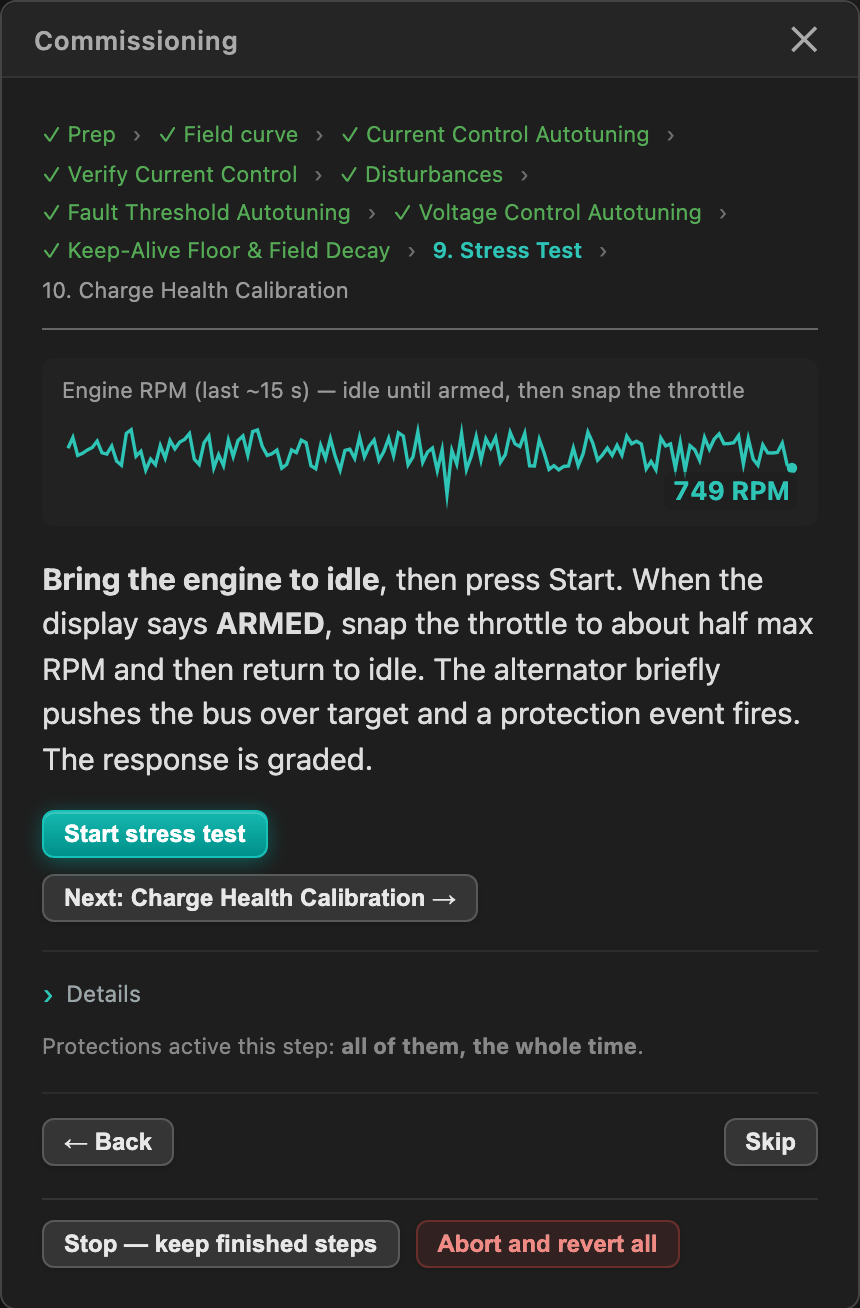
What you do
- Bring the engine to idle and press Start stress test.
- Wait while the XREG-010 settles the battery and holds the bus at its target — it announces each stage. When the screen shows ARMED, snap the throttle: accelerate as briskly as you can to about half of maximum RPM, then come straight back to idle. A rapid blip, not a hold.
- Hands off. The test records the recovery and ends itself a few seconds after the voltage has settled back at the target — you never press anything to finish it.
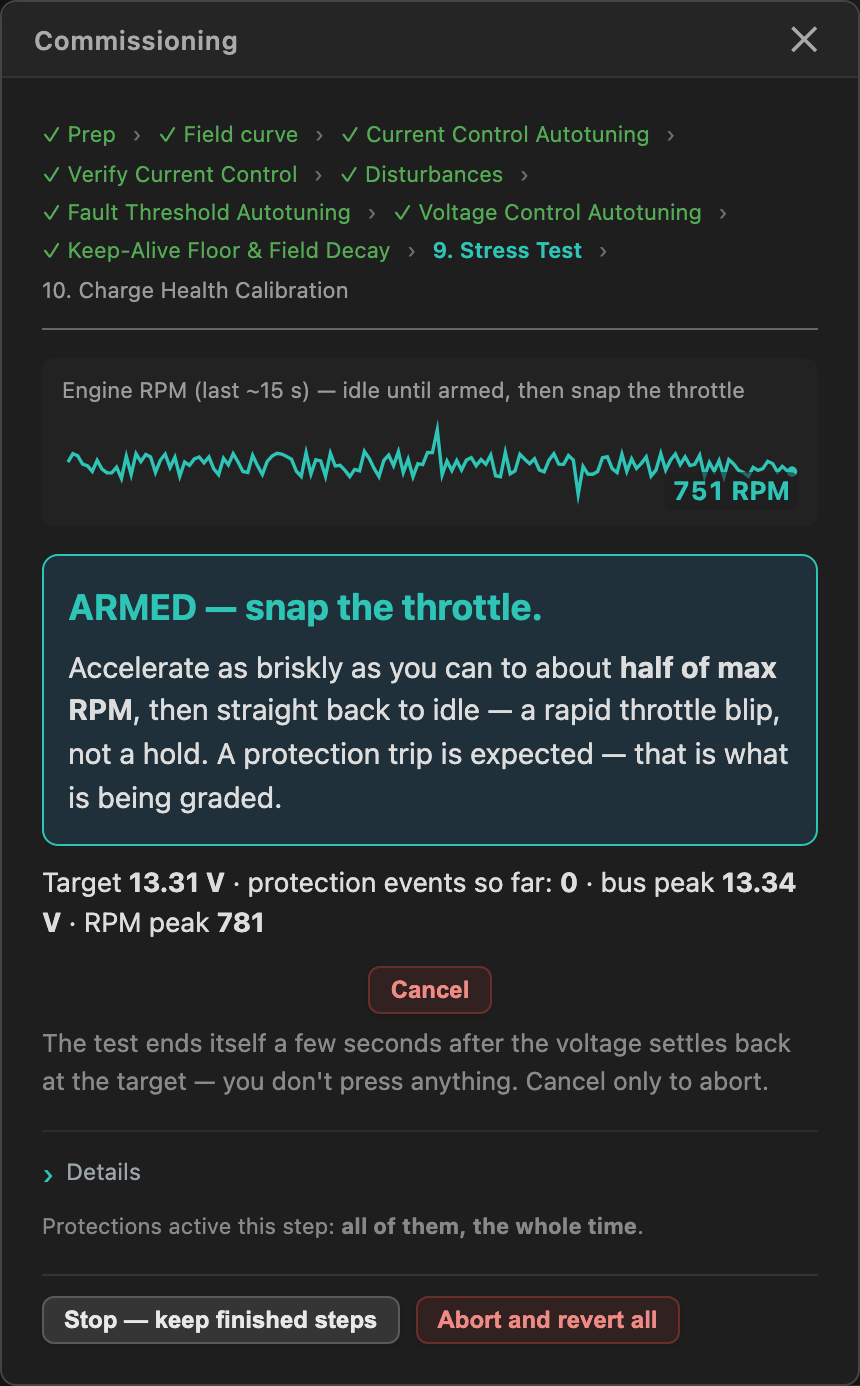
A protection trip is expected: that is what is being graded. A gentle snap that never trips is also a pass (the control loop kept the voltage below the trip level); the result just notes that a harder snap would prove more, if your engine allows one.
What the test does at each stage
- Settle at idle. The regulator charges normally until the filtered battery voltage holds within 0.10 V over 3 seconds. It must also stop rising slowly, because charging keeps raising the bus voltage long after a 3-second window looks flat, and a target fixed against a still-rising average reads low, leaving the current limit rather than the voltage loop in control of the field. So the voltage must additionally hold within 0.10 V of a drifting reference for 10 seconds, waited at most 30 seconds. If it can't settle within 45 seconds, the run proceeds anyway with the swing reported as a marginal stability grade (as long as it stays within the fail band); only a larger swing is graded a fail on basic stability — the bus voltage never stayed steady enough to fix a target.
- Hold at a reachable target. The target is set 0.10 V below the settled idle voltage (the Target Headroom Below Idle setting, Setup → Alternator → Tuning → Stress Test) and the regulator enters constant-voltage hold at it, waiting for the same stability rule again — this time also requiring the bus to arrive within half the target headroom, so the approach transient is over before the armed measurement begins. On a very large or very full bank the loop can shed all its charging current and the bus still not come down by the headroom; that is reported as its own failure — bank too stiff, reduce the Target Headroom and re-run — rather than being reported as a control-loop fault.
- ARMED. From here the test counts every protection event, tracks the voltage peak and the dip after the cut, and reads engine speed to measure how hard the snap was.
- Auto-end. Once the voltage has climbed back to the target from below and held the stability window, the run grades itself and shows the verdict. If no snap is ever detected the run times out and aborts; if the voltage never re-settles, that is recorded as a failed recovery.
All voltage figures here are for a 12 V system — they scale automatically with the system voltage class.
What a recovery looks like
The voltage spikes above the target, the protection cuts the field, the voltage dips well below the target (the field is gone and the loads are still there), then rises slowly back as the control loop rebuilds the field. The spike matters least; the protection cut the field and stopped it. The time and the risk are in the dip and the climb back, which is why the grades focus there.
How it's graded
| Category | What is measured | Grade |
|---|---|---|
| Pre-test stability | The battery voltage held 0.10 V / 3 s so a target could be set | Clean = pass; a swing within the fail band = marginal; beyond it = fail (the test can't arm) |
| Protection events | Each protection firing counts. A firing within 0.3 s of the previous one releasing is the same surge detected by a second detector and counts once. A protection that releases, lets current climb back, and fires again counts each time, because that cycling is itself a fault | 1 ideal, 0–1 pass, 2 marginal, 3+ fail |
| Hard current cut | A field cut fired by one of the two current-based protections: hard overcurrent (the electronic fuse, on alternator current) or load dump (on battery current slope). Both are harsher than the voltage clamp | None = pass; any = fail |
| Recovery time | First protection event to the voltage re-settled at the target | ≤ 12 s pass, 12–20 s marginal, > 20 s fail |
| Post-recovery stability | The 0.15 V / 5 s re-settle achieved after the event | Clean settle = pass; settled but still swinging within the fail band (after a further 5 s of grace) = marginal; never re-settled = fail |
| Overshoot | Peak voltage above the target | Reported for context — never fails on its own |
| Recovery dip | How far below target the voltage fell after the cut | Reported for context — never fails on its own |
The overall verdict is the worst grade among the gated rows. Overshoot and the dip never gate because on their own they aren't the harm: a tall spike the protection stopped once and recovered from cleanly is the system working. Repeated clamping, a current-sensor cut, or a recovery longer than 20 seconds is the system not working, and those are what fail.
Example outcomes
Blue is battery voltage, the gray dashed line the constant-voltage target, the amber dashed line the protection trip level, and each red dot one protection event. The horizontal axis is seconds after the snap.
Clean single event — PASS
The protection fires once, the voltage dips and climbs back within about 10 seconds, then holds the stability window. One event is the ideal — the protection did its job exactly once and the loop returned the voltage to the target.
Stayed below the trip level — PASS
The voltage rises briefly above the target but never reaches the trip level — the control loop kept the whole transient below the trip level and there is nothing to recover from. If the snap was gentle (a slow-revving engine), the result adds a note recommending a harder snap if the engine allows one; if it can't rev faster, this stands — a harder snap is not possible on this engine.
Double-dip — MARGINAL
The protection fires, the voltage climbs partway back, then trips a second time before it ever re-settles. It does recover, but slowly. Two events and a 12–20 second recovery both grade as marginal: not ideal, not a failure — worth a corrective action and a re-run.
Repeated cycling — FAIL
Spike, dip, partial climb, spike again — the loop keeps overshooting into the protection and never re-settles. Three or more events is a fail on its own, and so is a recovery that never completes. This is the signature of a voltage loop tuned with gains too high for the installation, and exactly what the corrective actions below address.
Reading the result
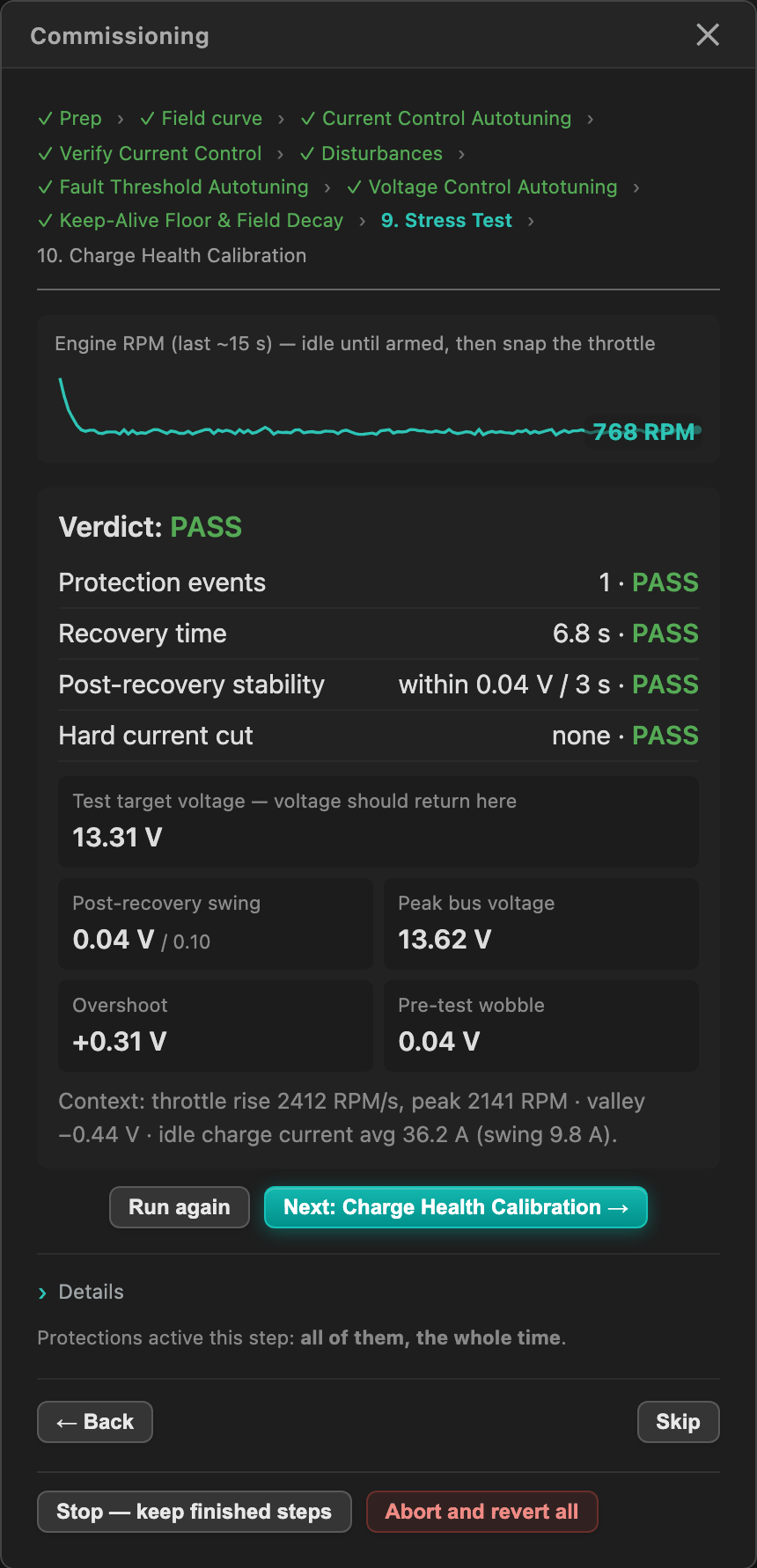
The verdict card lists each gated category with its grade, plus a context line: how hard the throttle snap was (RPM rise rate and peak), the target used, and the ungated overshoot and dip figures. The last result is kept and shown when you come back to this step later.
If it fails
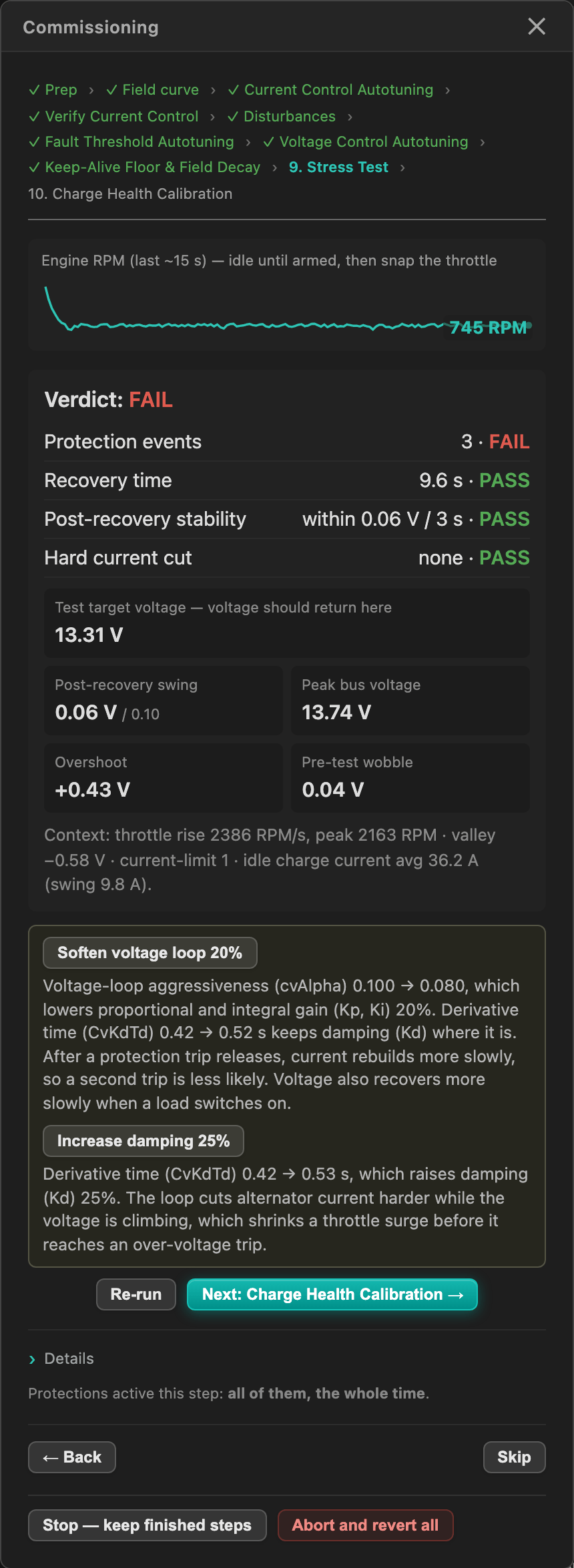
A poor result comes with one-press corrective actions matched to the failure signature. Each button comes with a line naming the setting it changes, with the old and new values, and saves the setting when pressed. Press Re-run to check the result.
- Soften voltage loop 20% lowers the voltage loop's proportional and integral gains by 20%. After a protection releases, current rebuilds more slowly, so a second trip is less likely. Voltage also recovers more slowly when a load switches on. Under the Measured gain source the button lowers CV Aggressiveness (α) and raises the derivative time by the same ratio, so damping stays where it was. Offered after repeated protection events or a hard current cut.
- Increase damping 25% raises the derivative (damping) gain by 25%. The loop cuts alternator current harder while the voltage is rising, which shrinks a throttle surge before it reaches an over-voltage trip. Offered after repeated protection events.
- Turn on Recovery Refill switches on Recovery Refill (Protections page). After a protection releases, the loop rebuilds the missing current faster, paced by the live voltage error. Offered when recovery was slow and Recovery Refill is off.
Relation to the other steps
The verdict grades the tuned system, so re-running any tuning step it depends on (the Field curve, either current-loop step, or Voltage Control Autotuning) invalidates a previous Stress Test result, discards the stored verdict, and clears its tick mark. The wizard does not add this step to the pass that did the re-tune, because it writes no settings and is optional. Once that pass ends, the Commissioning tab ticks it again for the next pass, along with any other step not yet run.